










Why Is Actual Car Mileage Different From Claimed Mileage?
 3 hours ago
 132 Hits
Why Is Actual Car Mileage Different From Claimed Mileage?
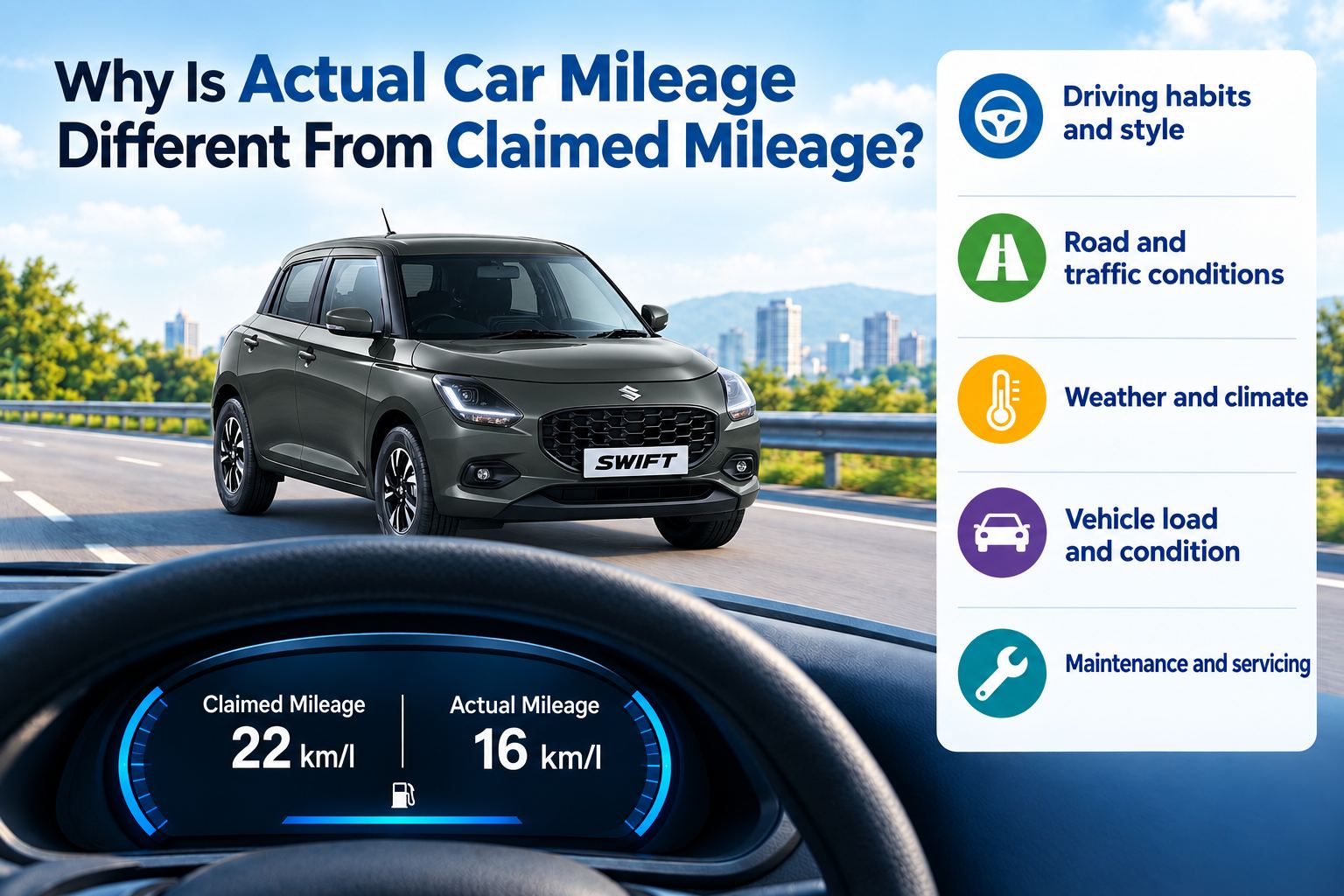
The car in question has an amazing figure for mileage as its advertising feature, but when you start using it, the number that will come out in your calculations will be quite different from what was claimed. The question that arises for many people at this point is whether the car delivers as advertised.
In this case, it does not necessarily have to mean that the car is not delivering as it should be. There is a difference in the way that the mileage claimed by a car and its mileage in practice are measured. While the former is calculated in an environment that is controlled, the latter is subject to all sorts of influences.
What Does Claimed Car Mileage Actually Mean?
The mileage mentioned by a car company refers to the result of an evaluation process following a standard procedure. In India, fuel efficiency statistics come out following the testing procedure specified within the applicable regulation and are meant to give a standard for comparing different cars.
Testing takes place under controlled circumstances and not under normal road circumstances. Things like speed, acceleration, brake use, and weight of the vehicle, among others, are controlled in the testing process and hence make a uniform standard by which cars can be compared.
The important thing is that the mileage claimed cannot necessarily be seen as a promise of the result that any car owner will obtain in his normal daily driving. It only denotes the efficiency obtained in the testing process.
For instance, there is a car which claims to have a mileage of 20 kilometers per litre, but the owner of the car can get less than this when he drives it in urban centers with many stops, among others.
What Is Real-World Car Mileage?
Real-world mileage is the mileage that your vehicle will produce when you drive under normal circumstances. Real-world driving differs from laboratory tests, as real-world driving is unpredictable.
It includes traffic lights, traffic jams, road work, hills, hard braking, changing weather, and variable speeds. The number of passengers and amount of luggage can also change the load on the vehicle.
Your daily route itself can make a difference. Someone who primarily drives on open highways may record a very different figure from another driver using the same car for short trips through busy urban roads.
The real-world miles per gallon, therefore, depends upon the driver who drives the vehicle. This is proven by independent road testing, as well. In this respect, for example, the test carried out by V3Cars on different models reveals that real miles in cities and highways can vary greatly from the figures provided by ARAI.
Why Is Actual Mileage Lower Than the Claimed Figure?
There are many factors that can make everyday mileage lower than the advertised mileage.
- Traffic: Many traffic lights, stop signs and congestion force one to constantly brake and accelerate, which takes up much more fuel than constant speed.
- Air conditioning: When an air conditioner is used, it puts additional strain on the car, which influences fuel economy, especially in the city where you cannot drive at higher speed.
- Carload: If there are many passengers and/or cargo inside, this makes the car heavier and requires more fuel to operate.
- Tyres: Tyre pressure is an important part of fuel efficiency since incorrect tyre pressure may increase rolling resistance, thus decreasing fuel economy.
- Driving style: Aggressive driving with rapid accelerating, braking and high rpm of the engine will make your car burn more fuel.
- Road and weather conditions: Various slopes, road surfaces, winds, temperature and other weather factors can influence fuel economy.
- Car condition: Maintenance of the car is very important for its efficiency, and factors like tyres, engine condition and servicing should be taken into account.
These factors can overlap. A driver dealing with heavy traffic, frequent short trips, air-conditioning and an additional passenger load may naturally see a lower mileage figure than the controlled test result.
City Driving vs Highway Driving: Why Does Mileage Change?
One of the most noticeable differences in mileage comes from where you drive.
City driving typically involves frequent acceleration, braking, idling and changes in speed. Traffic congestion can make this even more pronounced. Every time a vehicle slows down and accelerates again, energy is required to bring it back up to speed.
Highway driving, on the other hand, generally allows the vehicle to maintain a more consistent speed with fewer stops. This can result in better fuel efficiency, provided the vehicle is driven smoothly and within an efficient speed range.
Independent mileage testing reflects this difference. V3Cars' tests show that several vehicles recorded substantially different fuel-efficiency figures in city and highway conditions. In some cases, highway mileage was much closer to, and occasionally even higher than, the claimed figure.
This is why it is useful to consider your own driving pattern when thinking about mileage. A person who spends most of their time in city traffic should not expect the same efficiency as someone who frequently drives on open highways.
Does Driving Style Make a Difference to Mileage?
Yes. It is possible for two drivers using the same car on the same route to achieve different mileage rates depending on the way they drive.
Using gentle acceleration and deceleration reduces unnecessary fuel use. A stable speed under conditions of the road is often more efficient compared to continuous speeding up and stopping.
The aggressive speeding up uses fuel, while idling uses fuel unnecessarily without covering any distance.
In conclusion, there are some simple measures that one can implement to ensure efficient use of the fuel.
Avoiding unnecessary acceleration, observing the road conditions, and having a stable driving pattern can assist with that. Maintenance of the vehicle is another factor.
Should Car Buyers Trust the Claimed Mileage?
The claimed mileage should not be dismissed simply because real-world mileage can be lower. It provides a standardised benchmark that helps buyers compare vehicles tested under the same framework.
At the same time, buyers should avoid treating the figure as an exact prediction of their future fuel consumption.
Instead, consider your expected usage. Think about how much of your driving will happen in cities, how often you use highways, how many passengers you typically carry and whether you regularly use the air-conditioner. These factors can give you a more realistic idea of the mileage you may experience.
Independent road tests and owner-reported mileage can also provide additional context. However, these figures should themselves be treated as indicative because individual driving conditions vary.
How Can Drivers Get Closer to the Claimed Mileage?
It may not always be possible to match the quoted mileage, but some things can be done by drivers to increase their mileage figures.
- Check the tyre pressure.
- Follow the routine service schedule.
- Do not use excessive speed or sudden braking.
- Remove extra weight from the vehicle.
- Do not let the engine idle unnecessarily.
- Use the air conditioner appropriately.
- Maintain constant speed where the road conditions permit.
- Plan the route to reduce any unnecessary traffic and stop-start conditions.
- Take note of any changes in mileage that occur consistently.
If you find that there is a consistent or a sudden drop in your vehicle's mileage relative to the mileage quoted for the vehicle, it would be advisable to have your vehicle checked rather than attributing the drop to the figure quoted. In some cases, there may be variations in the vehicle's efficiency.
In summary, the question of Why Is Actual Car Mileage Different From Claimed Mileage is all about the difference between test driving and real-life driving. The quoted mileage provides you with a standard figure while your mileage depends on how, where and in what conditions you drive.
Read to Know: Why Maruti Suzuki Victoris One Of India’s Best Midsize Suvs?
Keep Your Car Running Efficiently with Indus Motors
One of the prominent Maruti Suzuki car dealers in Kerala is Indus Motors, which has many centers selling cars and providing workshop services throughout the region. The Indus Motors have several districts with showrooms all over Kerala as well as many workshop service centers. Servicing plays an essential role in preserving your car's overall condition and performance. Should you need any service for your car, whether it be routine servicing or a checkup due to a sudden change in mileage, then you can get your car serviced at the nearest Indus Motors service center.
Contact us and start your journey with Indus Motors!
Read to Know: Why Monsoon Car Service is Critical for Safe Driving?